Wednesday, 17 November 2010

Assignment 4b

Book Analysis

Eco-chic The Fashion Paradox by Sandy Black

This book is a result of Black’s view (2008, pp.254) that there is a “need for more sustainable practices in fashion and textile design”. The author discusses how and why the fashion industry has altered over recent years in relation to sustainable design. Case studies are used to highlight companies and designers that have implemented change or been established as a result. Theses companies and designers are ethically aware and focused on producing eco-friendly products.

In recent times “western consumers have come to realise that complex ethical issues are hidden behind all of our fashion purchasing decisions” (Black, 2008) this means that consumers are now more likely to consider the impacts of their purchases. As a result the contents of this book are important and relevant to current designers.

Black (2008, pp.14-18) begins this book with “The greening of the fashion industry” posing questions such as “How can fashion become more environmentally and ethically sound?” and “How can we consume clothing with a clear conscience?” with the key theme throughout the book being sustainable design.

Black’s own ideas and opinions as a Professor of Fashion and Textile Design and Technology as well as sourced information were used to create this book. Black gathered information during a project she carried out in 2004-5 entitled Interrogating Fashion. Workshops she carried out as part of this research allowed her to gain information from Susannah Dowse (TRAID remade), Kate Fletcher, Phil Patterson (Marks and Spencers) and many other designers and retailers who provided a key insight in to sustainable design. Black also interviewed numerous people to compile the case studies.

Black’s view is that most people are aware of their impact on the planet but few feel empowered to make changes. However she states that this is changing as due to increased awareness there is increased demand causing more companies and designers to produce sustainable goods. However producing sustainable items could lead to a decrease in a companies profit if fair wages were paid and sustainable raw materials were sourced for example. A decline in profit is obviously not desirable. As well as this some consumers may not realize the extent of the problems caused by the textile industry or ways in which they can make sustainable purchases. Others may not care about the detrimental impacts their purchases have, as long as the items they buy are fashionable and reasonably priced.

As a result of development in areas such as “fibre production, textile dyeing, minimizing waste of energy and resources, and addressing labour rights” (Black, 2008) the author concludes that the fashion industry is becoming more sustainable. As well as this it is said that there is not one answer, but “many strategies can be adopted to minimise environmental impact within the design and production of fashion” (Black, 2008). It is also suggested that everyone is responsible for the impact of his or her actions and decisions, thought should be made at every step from design and manufacture to purchase and recycling.

Reference List

Black, S., 2008. Eco-chic The Fashion Paradox. London: Black Dog Publishing Limited.

Journal Analysis

Sensitizing Children to Ecological Issues through Textile Eco-Design by Taieb, A.H. Hammami, M. Msahli, S. and Sakl, F.

This journal discusses the ways in which the design of textile products has the potential to improve everyone’s quality of life and create a better future. Throughout the journal there is particular emphasis on the importance of involving children in design. It is also deemed necessary to raise the awareness of ecological problems relating to the textile industry to children, as children are the future. The importance of using sustainable technology and materials is highlighted with the opinion that we can only “build a better world for the future” (Taieb, Hammami, Msahli and Sakl, 2010) if we constantly consider the environment throughout the design process.

The key question deliberated in this journal is “how can we make things better for people and the environment through the textile products we design?” (Taieb, Hammami, Msahli and Sakl, 2010) In order to suggest solutions to this question information gathered from a research project in Tunisia is discussed. The project “aimed to design functional ecological textile products for a more sustainable future” (Taieb, Hammami, Msahli and Sakl, 2010), children were involved in the entire design process as much as possible. The idea behinds this was to gain an insight in to the way children think. The project also hoped to determine how aware children are of current ecological problems and how much they understand, as well as how important and relevant the children think the problems are. Children’s drawings were interpreted to gain answers to some of these questions. The children were also asked to complete questionnaires as part of the research, questions such as “do you know what makes ecological pollution?” (Taieb, Hammami, Msahli and Sakl, 2010) were asked. It was found that “children have considerable knowledge about ecology and environmental pollution and expressed positive attitudes towards ecology and its promotion.” (Taieb, Hammami, Msahli and Sakl, 2010) However this was based on a study of 8-11 year olds in Tunisia, the findings are therefore not representative of all children. The knowledge of children in Tunisia is likely to be very different to that of children in the UK for example.

Within the text the use of sustainable materials such as natural fibres are discussed as are textile manufacture legislations with the conclusion being that “all consumer textile products, even green ones, have negative repercussions on the environment. They are manufactured using raw materials, energy and water, before being packaged and transported to their place of use, and eventually finishing up as waste.” However the authors of this book reiterate what Black (2008) writes in “Eco-chic the Fashion Paradox” that consumers and designers are becoming increasingly aware of environmental problems, which the textile design industry contributes to. Therefore the customer is now much more likely to consider the impacts of their purchases and this is set to increase in the future. It is also again suggested that there are a great number of ways in which textile products can become more sustainable, but there is not one simple answer.

Reference List

Black, S., 2008. Eco-chic The Fashion Paradox. London: Black Dog Publishing Limited.

Taieb, A.H. Hammami, M. Msahli, S. and Sakl, F., 2010. Sensitizing Children to Ecological Issues through Textile Eco-Design. International Journal of Art & Design Education [e-journal] 29 (3), 313-320 Available through: Web of Knowledge database [Accessed 13 November 2010].
Wednesday, 27 October 2010

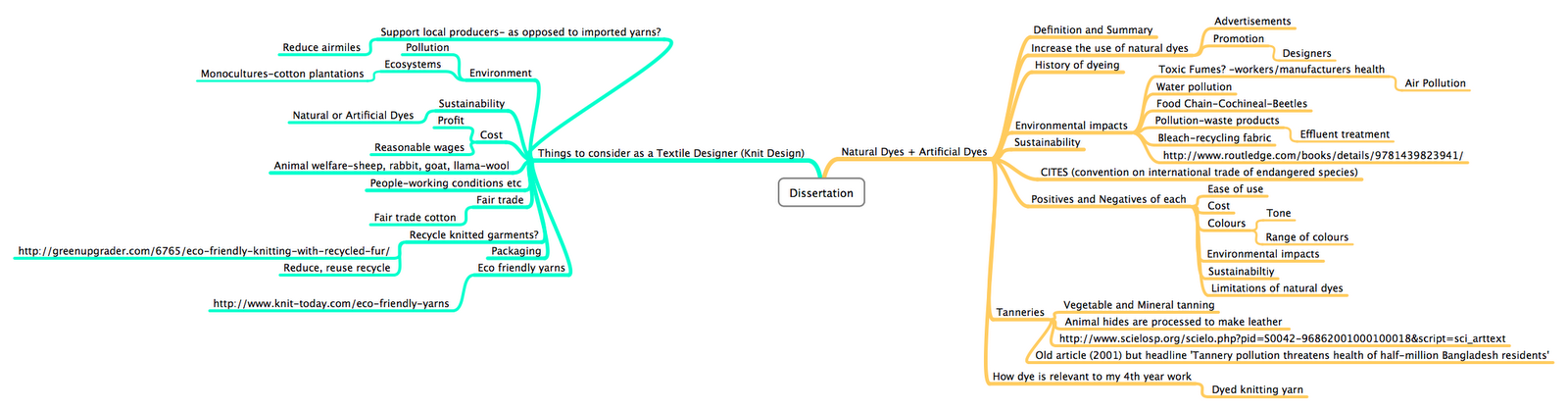
Assignment 3: Initial Dissertation Mind Map

Assignment 3

Dissertation Proposal Meeting and Workshop

Before the dissertation workshop took place we were asked to once again meet up with our groups this time to discuss our dissertation ideas, unfortunately only 4 of us attended the meeting. However we had each created a mind map of our initial dissertation ideas, which we discussed during the meeting. Most of us had no clear idea of what we wanted our dissertation to focus on but numerous directions in which it could go. Which I think was a good start, as lots of ideas and sources of inspiration are better than none.
Below are some images of our meeting:


Please note my initial dissertation mind map can be viewed in a separate post.

Before today’s workshop I had numerous ideas and interests, which I have come to realise as a result of the workshop, were mostly centralised around the environmental impacts we have as designers. I still have a lot of thinking and research to do but I am currently in the process of filling in part 1 of my dissertation proposal. I will add more detailed thoughts and ideas regarding my dissertation to my blog in the near future.

Wednesday, 6 October 2010

Assignment 2: Fair Trade & Design


Definition of fair trade

Fair trade is “trade that supports producers in developing countries by making sure that they receive fair wages” (Allen, 2002, p310). This means that hard work often in the form of manual labour is recognized and workers are paid accordingly, they earn enough to live on and continue to produce goods sustainably as a result of fair trade. Fair trade producers must adhere to strict economic, environmental and social standards set by the Fairtrade Labelling Organizations International (FLO) in order to be certified fair trade. For example, “the environmental standards set aim towards helping farmers to work towards using more sustainable farming practices. These standards include minimising the use of synthetic fertilizers and pesticides and where practical working towards organic production” (People & Planet, 2010). Companies buying and selling fair trade produce must ensure respectable, sustainable prices, which are never less than market price. Fair trade aims to not only alleviate poverty but generally to improve the standard of living for disadvantaged workers and their families. This can be achieved in numerous ways. For instance healthcare and education system can be improved with the provision of scholarship and pension schemes. Any fair trade scheme should be sustainable locally and insure comfortable working conditions as is explained on The Fairtrade Foundation website (2010). Fair trade should lead to gradual and constant improvement in developing countries.

A brief history of fair trade

The concept of fair trade has arguably been around for at least the past 40 years but an official labeling scheme was not created until the 1980s. On The Fairtrade Foundation website (2010) it is explained that the first fair trade label was launched in 1988. The label was branded 'Max Havelaar' who was known to be a fictional Dutch character against the exploitation of coffee pickers. The first fair trade coffee was also branded ‘Max Havelaar’. The Fairtrade Foundation was created 4 years later in 1992 but it was not until 2 years after this that the first fair trade certified product Green & Black’s Maya Gold Chocolate was launched (The Fairtrade Foundation, 2010). The Fairtrade Labelling Organizations International (FLO) was established in 1997 to standardize worldwide labelling and certification of fair trade goods. 5 years later in 2002 FLO created the International Certification Mark in order to make fair trade products easily recognizable (The Fairtrade Foundation, 2010). In the United Kingdom a fair trade certified product displays the fair trade mark, this “is an independent consumer label which appears on UK products as a guarantee that they have been certified against internationally agreed Fairtrade standards” (Fairtrade website, 2010).


This is the Fairtrade International Certification Mark. The image was sourced from (Harrogate Borough Council, 2010).

1994 saw the launch of the first fair trade certified product but now “the popularity of fair trade is growing swiftly in many parts of the world. As the fair trade market has grown, new kinds of participant have emerged and the field has become increasingly commercialized” (Laine, 2009). We know this is true as in 2003 there were only about 150 products with the fair trade mark, this increased to 700 products by 2005, more than 1,500 products in 2006 and now there are over 4,500 products with the fair trade mark currently for sale in common high street stores (The Fairtrade Foundation, 2010). Lush and Boots are examples of high street stores that now stock fair trade beauty products, Tesco stocks fair trade clothes (manufactured using fair trade cotton), food and drink products and even fair trade flowers.


This image showing fair trade produce for sale in a typical supermarket is from The Fairtrade Foundation website (2010) and the photographer is Marcus Lyon.

Another organization, which plays a part in the history of fair trade, is known as the World Fair Trade Organization (WFTO). This is the global authority of fair trade. The WFTO is limited to organizations that are 100% committed to fair trade and must abide by the 10 principles of fair trade as outline by the WFTO (2010). The organization now operates in 70 countries and has been in place for around 20 years.

The relevance of fair trade to design

Since the creation of the Fairtrade International Certification Mark in 2002 it has been found, based on a study of small scale coffee producers in Central America and Mexico, that the introduction of “certifications provided a higher price per pound and higher gross coffee revenue than non-certified coffee” (Mendez, 2010). However “certifications will not single-handedly bring significant poverty alleviation to most coffee-farming families” (Mendez, 2010). This is because not enough people choose to buy fair trade produce and more money is needed to create sustainable livelihoods, develop conservation, provide health care and education. Most producers are currently unable to sell their entire production at certified prices due to lack of demand.

This is where design comes in. Design is a broad term and has numerous different meanings but for this purpose it will be defined as “to create or execute according to a plan” (Allen, 2002, p232). The plan in this case would be to use design to increase the consumption of fair trade products. By doing so, more producers and workers would benefit from fair trade and therefore have the financial sustainability to help alleviate poverty and enhance the standard of living in their community.

Design and designers have the potential to influence people and their actions. Small changes can make a significant difference to those in developing countries, design can be used to persuade and encourage people to make these changes. For example media and graphic design could be used to emphasize the differences that individuals in this country could make to the lives of others by simply swapping to fair trade tea, coffee or hot chocolate. Highlighting the poor living and working conditions as well as the overall poverty, poor education and healthcare systems in such areas with posters, product labels and advertisements could also persuade people to think again when deciding whether to buy a well know brand as opposed to fair trade. Product placement within films and television shows could be used to raise the profile of fair trade produce. Another option that could increase sales is creating advertisements, which lead the consumer to associate fair trade with popular celebrities. For example Gary Lineker is used to advertise Walkers crisps.

Textile design and designers can also help to alleviate poverty in developing countries through the use of fair trade cotton for example. Currently there are websites such as http://www.fashion-conscience.com/ and www.peopletree.co.uk, which sell fair trade clothing, and there is a fair trade range called 5g that is sold by Debenhams. This range includes Sir Steve Redgrave’s designs. As well as this there is an annual fair trade fashion show known as ‘The Fairwear Fashion Show’ where Harry Potter actress Emma Watson showcased her fair trade range (WFTO, 2010). However more can be done. If one or two top fashion designers decided only to design and create fair trade fashion this would generate a lot of publicity and would undoubtedly gain public support of fair trade products. Making fair trade fashionable to numerous social groups can mean peer pressure works as an element of persuasion to buy fair trade, this is suggested by Doran (2010). Designers could also design T-shirts, bags and other similar merchandise to promote fair trade. These methods are a selection of the numerous ways in which design could be used in relation to fair trade, to address the problem of poverty, poor working and living conditions, lack of education and healthcare in developing countries.

Word Count: 1,274

Bibliography

Allen, R (ed.) (2002). The Penguin English Dictionary. London: The Penguin Group

Doran, CJ (2010). Fair Trade Consumption: In Support of the Out-Group. Springer

Harrogate Borough Council (2010). Fairtrade in the Harrogate District Available from: http://www.harrogate.gov.uk/harrogate-3926 [Accessed: 3rd October 2010)

Laine, EL (2009). Finnish World Shops at a Crossroads in the commercialized Fair Trade Market. John Wiley & Sons, Ltd.

Mendez, VE (2010). Effects of Fair Trade and organic certifications on small-scale coffee farmer households in Central America and Mexico. Online: Cambridge University Press 4th Jun 2010.

People & Planet (2010). About Fairtrade. Available from: http://peopleandplanet.org/fairtrade/about.php [Accessed: 2nd October 2010]

The Fairtrade Foundation (2010). What is Fairtrade? Available from: http://www.fairtrade.org.uk/what_is_fairtrade/faqs.aspx [Accessed: 27th September 2010]

The Fairtrade Foundation (2010). Fairtrade labelling international history and Fairtrade Foundation chronology [Online]. Available from: http://www.fairtrade.org.uk/what_is_fairtrade/history.aspx [Accessed: 2nd October 2010]

The Green Planet (2009) Will Fairtrade ever expand into the fresh produce segment? Available from: http://en.greenplanet.net/food/fairtrade/994-will-fairtrade-ever-expand-into-the-fresh-produce-segment.html [Accessed: 2nd October 2010]

WFTO (2010) Harry Potter star Emma Watson’s designs at Fairwear 2010 fashion show. Available from: http://www.wfto.com/index.php?option=com_content&task=view&id=1127&Itemid=314 [Accessed: 2nd October 2010]

WFTO (2010) Welcome to the source of authentic Fair Trade. Available from:

http://www.wfto.com/index.php?option=com_content&task=view&id=889&Itemid=290

[Accessed: 2nd October 2010]


Monday, 4 October 2010

Assignment 1: The 2nd Group Meeting

Below are some photographs of our second meeting which i wrote about in an earlier post.


Saturday, 2 October 2010

Assignment 1: Mind Maps + Another Meeting


I produced these 2 above mind maps (click to enlarge) prior to the meeting with my group on Wednesday in which we discussed how we were all getting on with the assignment. I found it easier to organize my thoughts using 2 mind maps. One based solely on fair trade and the other linking design to fair trade. Everyone had produced a relatively thorough mind map, which may be developed and added to as new information is found. All the members in my group have now also set up and are using a blog. Now we are all continuing to write about our chosen topic for the deadline next week.

We also discussed the previous lecture and our views towards branding. With one graphic design student very much in favour of branding and another against very commercialised branding such as McDonalds and Starbucks preferring small restaurants and cafes to chain restaurants and stores for example. I was surprised to find that another member of our group chooses to completely avoid numerous brands such as Coca-cola.


Sunday, 19 September 2010

Assignment 1: Design Futures and Professional Practice

Eventually I have got to the end of a somewhat hectic first week back at university. During the week I have been busy with numerous lectures and tasks. As well as this my class visited Arbroath on Tuesday on a drawing trip, which will hopefully help to prepare us for a project, which we are beginning on Monday. I also visited Tentsmuir and Tayport on Friday with some friends to collect relevant drawn information and photographs.

In design studies we have been put in to interdisciplinary groups in which we will have assignments to complete. This week we were asked to meet with our group and discuss a list of topics on which we will each write a 1500 word Wiki entry. Below are some photographs taken at the meeting we held on Thursday afternoon at 1.30pm in the graphic design studio.


Everyone attended the meeting and we discussed the topics. We could each choose our own topic but no 2 people in the group could write about the same topic. I think we all struggled to decide what topic we wanted to do and some people were very indecisive and had 2 or 3 options. This is probably because we had little time to research the options prior to the meeting. After some brief discussion we settled on the following topics:

Samantha: Fair trade & design

Natalie: Design process & design (also interested in Culture & design and Art & Design)

Sarah: Gender & design

David: Interactivity & design

Robert: Co-design & design

Sean: Mass production & design

Sophie: Corporate identity & design

Collette: Branding & design

We finished the meeting by swapping blog addresses, and deciding that those who don’t have a blog will need to create one by our next design studies lecture on Wednesday and provide the other group members with the address. We also agreed to mind map our selected topic and perhaps begin gathering sources before our meeting next Thursday.