

Wednesday, 14 October 2009

Tuesday, 13 October 2009
Culture Project 2
I have now moved on from looking at how to grow a tomato to the second section of my culture project-something my dad doesn't know. What i have decided to concentrate on now is that my dad doesn't know what it is like to be on the moon. I want this section of my sketchbook to be visually very different to the last section of my project so i have decided to work mainly in black and white rather than vivd colours. Any colour i use in this section will be understated and carefully considered. I have also decided to work on a larger scale and fine detail will be less important. So far i have only began to consider the surface of the moon looking at reference books and interesting surfaces in the natural environment for inspiration. I have particularly enjoyed experimenting with masking fluid to create unusual layered images and creating different textured surfaces to work on with thick white emulsion paint and collage papers.


Culture Project 1

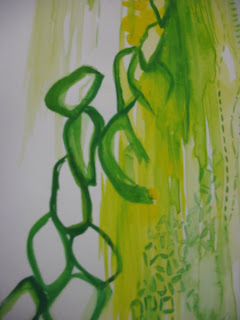
Recently I have been doing a lot of work on my Culture project. Still progressing with the theme of how to grow a tomato I have looked at garden tools, allotments and a variety of leaves based on photographs taken at the botanic gardens in Dundee. I have been inspired by the use of colour in Patrick Herons work, I also looked at the work of Mark Rothco who uses colour and composition in a very bold manner and textile designer Kate Blee. I feel Kate Blee’s work is likely to appeal to many people as it is contemporary and very minimalist. Some of her work and that of Mark Rothco and Patrick Heron is visible on the sketch book page above.
I based some of my work on my dads vegetable garden and greenhouses, i have also used inspiration from photographs i took at the botanical gardens in Dundee. A couple of photographs and pages from my sketchbook are shown below.



The Tipping Point
I have recently read 'The Tipping Point’ by Malcolm Gladwell and many aspects and ideas discussed in the book I found very interesting. Some of the ideas and concepts made me think about how things do happen and what makes them happen and even how we could control them, I began relating aspects of the book to my life. Being able to relate to the book increased its interest for me. Although areas of the book I did find repetitive and so slightly boring, however this use of repetition did cement the points being made in my memory.
Creating this mind map has helped me to understand ‘The Tipping Point’ more clearly and I found the process quite enjoyable, although I found some areas quite difficult to map out as there are so may connections and overlaps within the book. I particularly liked using MindNode as a tool to create this mind map, as MindNode is quick, neat, tidy and easy to use. It is a programme I will be keen to use to plan out my ideas in the future. Within my mind map I explored the epidemic section in greater depth than the other areas as I found this most interesting I concentrated particularly on the Hush Puppy epidemic. This is because I found it very surprising to learn that something so small as the actions of a few kids in East Village and Soho could make such a huge difference.
I think many things I have learnt from this book will be relevant to my studies in Textile Design and also in other areas of my life. For example, the information about the amount of trial and error necessary to create Sesame Street highlights the importance of testing, the need for lots of attempts, small adjustments and constant analysis whilst creating.It is also very useful to know Connectors, Mavens and Salesman if you wish to create an epidemic or increase sales or get something noticed. Small changes can make a big difference. A small reduction in the budget to treat syphilis can leave a few untreated Connectors, which can cause a large number of newly infected people. Changing the colour of a small area of a print could have a huge impact. Things happening all around us even small initially somewhat unnoticeable things can have a dramatic impact.
This is the mind map i created to explore the contents of the 'Tipping Point'

I then went on to look in more depth at the Hush Puppies epidemic.

Please note i have posted the two mind maps shown above separately, as here the images appear very small and the text is too small to read.
Friday, 2 October 2009
Dawn Dupree
I like to know what inspires people and on http://www.themaking.org.uk/Content/makers/2007/09/dawn_dupree.html Dawn Dupree says 'I like urban wastelands and empty spaces which have once been very busy or are about to be busy – they have a strange anticipatory, slightly loaded atmosphere that I like to express in my work' which I find very interesting. The images below are taken from http://www.dawndupree.com/domestics.html#and are two of the cushions from Dawn Dupree's domestic range which i particularly like.Since the lecture based on composition that I had on Monday I have had a look at the work of some of the artists and designers mentioned. I particularly like the work of Dawn Dupree who has been creating textile art since 1990. I like the bold colorful semi-abstract prints she creates, I especially like her work based on a shopping trolley and her range of ‘domestic’ cushions. I think her work is original, unusual and vibrant.

Culture Project
My culture project is rapidly developing and very enjoyable so it is probably about time I started to document my ideas. A few weeks ago I began with the idea that culture is what you know, what you don’t know and what you want to be. This idea I found online whilst researching culture with examples such as depending on your culture you may know how to catch a fish with your bare hands, build a mud hut or use a computer. You may want to be literate, an astronaut or able to afford to send your kids to school. This I found interesting and so decided to ask my family and friends these questions: What do you know? What don’t you know? And what do you want to be? I asked them to give me three answers to each question. However I ended up with too much information to work with so I decided to base my project solely on what my dad’s answers to the questions were.
My dad knows:
How to grow a tomato (Do all cultures grow and eat tomatoes?)
How to drive a digger
That he pays too much in taxes (I don’t think he does know this he just wishes it was true!)
My dad doesn’t know:
What it’s like to be on the moon
What it’s like to be rich (although in some places he may be considered to be rich)
He also doesn’t know how to fly a hot air balloon
My dad wants to be:
Happy
Healthy
Rich
(I imagined he would answer this question with a profession like my mum did- a travel writer/ photographer)
I have taken his first answer and so began investigating how to grow a tomato. During the past week or so I have been drawing directly from fruit and vegetables, looking at magnified images of fruit and vegetables and also banana cells under a microscope. I am now beginning to look at gardening tools, allotments, greenhouses, potting sheds and overgrown vegetable plots.
Below are some images of my sketchbook pages based on drawing from fruit and vegetables, the photographs within my sketchbook i found online. However i hope to visit the botanical gardens or some local allotments to do some photography this week.


Subscribe to:
Posts (Atom)


